
90
Dedicated to Juntaro Yamanouchi
Hiroyuki Okura was coming to Juntaro Yamanouchi's parents' house to tune the piano before Yamanouchi was even born. In the 1960s, his father's company was involved in a scandal, and he had to hide all over Japan, taking company documents with him. He had no peace of mind and could hardly sleep at night due to this. After several years, Okura finally returned home. He had become an alcoholic; he always kept a small bottle of whiskey in his pocket, which he drank all the time. But those hard years haven't twisted him, and he retained his unique, cheerful character.
When Juntaro was 5 years old, he would walk together with Okura, going to the park or shopping. Mr. Okura would often take a bottle out of his pocket and drink it—his drunken smile while looking at the clear sky is something Juntaro won't forget.
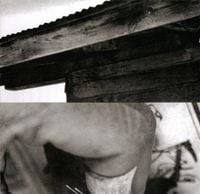
This album, Hell Driver, is dedicated to Hiroyuki Okura, whose mental strength Juntaro respects. It consists of recordings from 1992 to 1996, which was a difficult period for Juntaro (he mentions major events/a serious incident at his home; I don't know what it was). Produced/compiled in 1997 and released in 1999 on Dirter Promotions, it's one of the last Gerogerigegege albums, along with None Friendly, to be released before Juntaro disappeared (and eventually returned). Both are totally different from each other and the releases before them, especially. The Gerogerigegege's output up to this point mostly consisted of noisecore, (harsh) noise, punk, and sexual shenanigans. The project clearly had a sense of humor, but the more serious releases were there—none of them reached the same levels of bleakness as Hell Driver (even the depressing Endless Humiliation, which paired the ramblings of a homeless man with atonal piano improvisation, doesn't do that), nor did they reach the levels of beauty that None Friendly did. These two records are different, but one thing connects them: loneliness.
It's something you'll experience right from the start of this album thanks to ————, a collage of field recordings from 1992. A live house plays Julee Cruise's "Floating" (ironically, a beautiful love song, but its dreamy, jazzy sound manages to set the tone) on its speakers; Juntaro walks around; a crowd talks and watches a firework display; traffic and an ambulance siren can be heard. While these recordings show a city bursting with life, the mood they give off is just somber. It doesn't matter how many people are around you and how happy they are; solitude looms over you.
The audio cuts out, a hiss enters your ears, and 15 minutes of piano improvisation follow—welcome to the title track, recorded in 1994. The only accompaniment is a manipulated tape of piano improvisation and tape fuzz. There is some beauty to be found in the playing at times, but it's melancholic from start to end. The closer it is to finishing, the more often the piano disappears, leaving you alone with the fuzz for a while, until it just doesn't reappear anymore. What I find really interesting is that this quiet, lo-fi singing shows up while the piano cuts out.
The next track is a live performance on August 21st, 1996, at Club-Q in Shimokitazawa. The venue's PA system plays Massive Attack's "Sly", easing you in. When you think of a Gerogerigegege live show, you think of silly noisecore or Gero 30 and his shenanigans, but what ensues is nothing like that. You can hear the crowd chatting and rustling around, albeit in a distorted form. A while later, a guitar tuner starts buzzing, shifting a bit, and then, the performance truly begins. The guitar tuner produces an unpleasant, high-pitched drone varying in notes and speed for almost 35 minutes straight. The only things beside it are the aforementioned sounds of the audience and the occasional loud metal clang. The drone is digging at you: it's life itself torturing you; it's rising anxiety; it's pain building up. This track can be a hard listen for some, especially considering its runtime, but I personally think it's a masterpiece, the crowning jewel of this album.
The only thing that can come next is even more pain. After 2 minutes of people conversing, Juntaro starts playing Mr. Okura's original 1963 creation with no name—he apparently was an engineer making various inventions like instruments. Every pluck of the instrument sounds like it's getting tortured, screaming, and crying. The entire track plays only in the left ear, with a few frequencies escaping into the right channel. This was an October 30th, 1995, live performance at Muse Hall in Osaka. Before it, Juntaro stood in front of the instrument and offered a silent prayer, hence the name Pray Silently ~ Play for Late Mr. Hiroyuki Ohkura. If you do some searching, you'll find out that Juntaro used a koto for this show (I think you can even hear someone say "koto" at the beginning of it), and there's also a photo of him playing it. I'm certain it's an iron wire koto, as the 鉄線琴インプロビゼイション tape sounds very similar to this track.
The album is closed by another piano improvisation piece, Night Is Morning, this time from 1993. It's recorded from the inside of the piano, and there's no tape running alongside; you can hear all the creaks and thuds. It's not a return to the state from the title track; the playing paired with the sounds coming from the piano's insides sounds more pained. Hell, the instrument's moving parts sound like someone sobbing and breathing, or maybe that's Juntaro himself; I don't know. It's a bleak ending for this record. Initially, I said it "looped" in a way, but this sounds like a permanent change.
While Hell Driver isn't exactly some kind of Gerogerigegege deep cut, I think it deserves more attention (along with the rest of their discography). It's more depressing than its follow-up, Moenai Hai, which at least had a glimmer of hope at the end and whose centerpiece is a release of emotions. It's a harrowing experience; there's no other release like it in the Gerogerigegege's discography. I can't say I can relate to it fully (which I guess is a good thing), but I've certainly felt isolated from others. If this album truly reflects Juntaro's state of mind, I hope he's in a much better place nowadays (considering his depression in 2021 and recent disappearance—he hasn't been active on social media for a year, and apparently his e-mail now bounces back). An alternate reading for this album could be Hiroyuki Okura's feelings during his hiding, but it doesn't really fit the entire picture, thinking about it. I hope that everyone on this planet going through bad times can get their own >(decrescendo). This is the 4th time I'm reviewing this album, and I won't do any more rewrites in the near future for sure. Thank you for reading.
Track Ratings
| 3 | Moonlight & His Loser Knife (1996) / 100 |
Play This On
4
Comments

malicious power
11mo
of course i find out juntaro retweeted something on twitter after i wrote this
malicious power
11mo
@DuckV9 thank you!

HexDstasy
10mo
this is lowkey the best review I've seen so far
Sign in to comment.
Related Content
Advertisement
Rate and review albums along with the AOTY community. Create an account today.
Become a Subscriber
Subscriber badge, no ads + more benefits.
Subscriber badge, no ads + more benefits.