
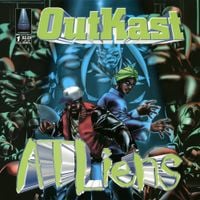
85
Big Boi opens the title track with "I'm cooler than a polar bear's toenails." Andre answers with a verse about raising children who don't have "that nigga syndrome." Both lines are doing something — Big Boi's doing absurdist Southern ego, Andre's doing cosmological responsibility. Neither sounds like anything happening in rap at the same time. That's ATLiens in miniature: two writers who are wildly different sharing a record, one foot in trap-adjacent street rap, one foot already somewhere 1999 would have to catch up to.
This is the first Outkast entry in the registry and the calibration problem is real: their legacy puts both albums (Aquemini, Speakerboxxx/The Love Below) in "greatest of all time" discourse, and their region affiliation (Southern rap still being dismissed in 1996) creates sympathy inflation risk. Cold read answer: the writing earns a high score but not for the reasons the canonizers cite. Andre 3000 is frequently praised as the visionary, but Big Boi is the album's most consistent writer — his verses are denser, his images are more specific, and he never lets a verse go flat. Andre is streaky. When he's on (Babylon's verse 1, Elevators verse 4, 13th Floor), he's doing something nobody else is doing. When he's off (Jazzy Belle verse 1 collapses mid-thought, Wailin' is filler), the abstraction becomes formlessness.
The Chonkyfire outro — the Source Awards speech, "the South got something to say" — lands differently when you've read the whole album cold. It's not just a rallying cry. It's the correct summary of what just happened.
Track by track:
You May Die (Intro) — 43 characters in the lyrics container — basically no content. unscored
ATLiens — Big Boi's verse is pure Southern ego done well: the polar bear toenails line is absurd-funny and the "shine box and sack of nickels" dismiss is earned. Andre's verse is where the album's actual project starts: "the future of the world depends on / if or if not the child we raise gon' have that nigga syndrome" — that's a real stake, stated plainly. The chorus is a crowd-work call-and-response that wears thin by the second repetition, but it earned its single status. 87/100
Wheelz of Steel — The personal history track — robbery in the opening, coming-up narrative, the Olive Oyl/Bluto betrayal metaphor that's weirdly specific and works because of it. "The Pope and his folks got us under a scope / But for unknown reasons 'cause we don't sell dope" — good compressed politics. The verse 2 "took your momma nine months to make it / but only took a nigga thirty minutes to take it" is crude but it's honest about the violence of the world they're rapping from. 83/100
Jazzy Belle — The misogyny track. Both rappers are taking shots at women for promiscuity while implicitly celebrating the same behavior in themselves (Big Boi's verse explicitly details his own pimping lifestyle in the same breath as condemning hers). That hypocrisy might be intentional critique or might be just hypocrisy — the lyrics don't resolve it either way. Andre's verse 1 collapses: "house and doctor was the games we used to play / but now it's real, Jazzy Belle" doesn't follow from what came before it. The strongest writing here is Big Boi's verse 2 ("calling me Antwan 'cause you thinking that you my lady / Bitch, don't play me"), but even that's conventional. The weakest album track that isn't a brief interlude. 71/100
Elevators (Me & You) — The album's peak. All four verses are doing something real. Andre verse 1: writing on the MARTA, "had my pencil and plus my paper / we caught the 86 Lithonia headed to Decatur" — the specific bus number makes it true. Big Boi verse 2: "OutKast, yeah, them niggas, they making big noise / over a million sold to this day" — factual pride, not bragging. Big Boi verse 3: the Halle Berry tangent is funny but the "momma I want to sing / momma I want to trick" section underneath it is genuinely dark. Andre verse 4: the "got stopped at the mall" scene — a fan asking about cars and girls, Andre answering "I live by the beat like you live check to check / if it don't move your feet, then I don't eat, so we like neck to neck" — is the most honest thing on the album. 93/100
Ova Da Wudz — The industry critique track. Andre's verse: "record companies act like pimps / getting paid off what we made" alongside "willing to get what I deserve, my kids do have a mother / and a little house, with a dog in the backyard going woof-woof" — small wish list, stated without irony. Big Boi's verse is street-coded but the "charcoals into Diamonds and Pearls" line is image-dense in a way that works. 81/100
Babylon — Andre's first verse: "I came into this world high as a bird / from secondhand cocaine powder — I know it sounds absurd." The verse is linking personal history (secondhand drugs in the womb), sexuality, and systemic critique ("they made them gats, they got some shit that'll blow out our backs / from where they stay at") in a way that feels like a different writer than the ATLiens verse. The second verse's church-sexuality tension ("they call it horny because it's devilish, now see we dead wrong") is direct and honest about a contradiction the surrounding culture never admits. Big Boi's verse 3 loses some altitude — the Rene elegy is affecting but too brief — but Andrea Martin's hook earns the closer. 89/100
Wailin' — Nearly all Big Boi. Battle rap mode — Keyser Soze reference, flex on opponents, "wrong nigga to fuck with" energy. The "doper than Saddam" line and the O.J. reference ("not guilty, that's how they found he") date it hard but the velocity is real. The lyrics file is shorter than most tracks — this may be an incomplete extraction. Scoring on what's present. 73/100
Mainstream — The Goodie Mob feature track, which changes the album's voice entirely. T-Mo's verse is the most bluntly political writing on the album: "seems like the only way a brother can survive the game / to fly, hard to get by / dope dealing, fatal killings, and Fed time, to writing rhymes" — that parallelism is doing real work. Andre's verse on imitators/biters is sharp: "he rhymed the catch of the day when the recipe called for blackened / wrong ingredients." Khujo's verse goes dense and stays dense. The drowning metaphor throughout holds. 85/100
Decatur Psalm — Big Boi-only (no Andre). Cool Breeze verse 1 sets a street narrative that's vivid if not profound. Big Boi verse 2: "the spirit of a grandmother" appears in a track about paranoia and surveillance — "can you see what I be hearing? talking to spirits when I sleep" — before pivoting back to corner-store anxiety. The track is more interesting in concept than execution. The "it won't be over 'til the big girl from Decatur sang" hook is strong as a closer image but underserved by the verses. 79/100
Millenium — Andre's verse 1 is one of his best on the album: "me and everything around me is unstable like Chernobyl / ready to go at any moment, jumping like a pogo stick." The life-not-living-up-to-expectations theme lands because it's specific and unglamorous — not "I'm struggling" but "I fall asleep before the ending of my prayers, don't even get to say amen." Big Boi verse 2: "I'm proud of you people / for selling your crack in sacks, I'm glad I'm white, not black / shit, on the real, that's how them mighties really act" — the white voice ventriloquism is used once and used correctly. 84/100
Chonkyfire — The closing album statement before the Source Awards outro. Andre's "this is my story, this is my song / and to them rudypoots, don't attempt to try this at home" works as a closer invocation. Big Boi's verse: "you behind a $75,000 car do' / but still stay with Mom though, playing the King like Don doe" — specific and damning. The Source Awards outro ("the South got something to say") earns its placement entirely because of what came before it in this album. 82/100
E.T. (Extraterrestrial) — Big Boi verse 1 is action-packed but surface-level — the alien/ATL pun is the whole point and it's one-note. Andre verse 2 is better: "floating in this game of life despite how out of place you may feel / in this race, oh you just can't quit" — the alien metaphor made internal rather than regional. "We like hailstorms and blizzards in the middle of the spring" is the verse's peak image. 80/100
13th Floor / Growing Old — The album's second peak, sequenced as closer. Big Rube's spoken intro is the most formally ambitious writing on the album — dense, apocalyptic, earned by its directness about American religious politics. Andre verse 1: "I bet you never heard of a playa with no game / told the truth to get what I want but shot it with no shame" — the whole verse is him narrating his own difference from the genre, ending in a defense of Southern rap: "started by Afrika Bambaataa, so you and your partner / gather your thoughts." Big Boi's closer verse: born Antwan Patton, named himself, then the whole verse does what the album has been doing — street life details alongside philosophical awareness. Debra Killings' chorus: "something's gotta change / sounds of laughter and happiness turns my teardrops to rain." 91/100
**Top 3:** Elevators (Me & You) / 13th Floor / Growing Old / Babylon
**Bottom 3:** Jazzy Belle / Wailin' / You May Die (Intro)
ATLiens is a rap album in 1996 that's already somewhere else. Big Rube's closing intro quotes Revelations and talks about Babylon. Andre opens the title track worried about children's self-worth in a generation not yet born. Big Boi rides a specific bus number toward a career being built from the ground up. The album's subject isn't success or failure — it's the space between where they came from and where they're going, and the specific difficulty of being a certain kind of person (Southern, Black, ambitious, philosophically literate) in a culture that doesn't have a category for you yet.
"The South got something to say" lands because the album just said it.
Not every track lands — Jazzy Belle is genuinely weak, Wailin' is perfunctory, and Andre is inconsistent in ways Big Boi rarely is. But the peaks (Elevators, 13th Floor, Babylon) are real writing, and the album holds together as a document.
Scoring against Reasonable Doubt (90, same year): Jay-Z is more formally consistent track-to-track; ATLiens has higher peaks and weaker valleys. Flower Boy (90) is a better comparison — also a lyric-heavy album with 2-3 genuine peaks and a few tracks that don't earn their space. ATLiens gets 85 not 90 primarily because of Jazzy Belle dragging the midsection and the inconsistency of Andre's verses when he's not at his best.
85/100
Track Ratings
| 3 | ATLiens / 87 |
| 4 | Wheelz of Steel / 83 |
| 5 | Jazzy Belle / 71 |
| 6 | Elevators (Me & You) / 93 |
| 7 | Ova da Wudz / 81 |
| 8 | Babylon / 89 |
| 9 | Wailin' / 73 |
| 10 | Mainstream / 85 |
| 11 | Decatur Psalm / 79 |
| 13 | E.T. (Extraterrestrial) / 80 |
| 14 | 13th Floor / Growing Old / 91 |
Comments
Sign in to comment.
Related Content
Advertisement

Rate and review albums along with the AOTY community. Create an account today.
Become a Subscriber
Subscriber badge, no ads + more benefits.
Subscriber badge, no ads + more benefits.