

85
“My eyes are up here, pal”
It’s pretty insane that not a lot of people talk about this band since they are a significant influence on many very beloved bands on here. I assume that's mainly because they’re a German band, and admittedly their catalog overall is not as interesting as something like SWANS. Still, I just have to look at my favorite albums, and most of them have at least a little bit of this band (or of the people involved with it) in their gene pool. They're a major influence on early SWANS, and some of their use of field recordings on this project in particular feels like it inspired later Post-Rock outfits. On top of that, Blixa Bargeld was a key part of Nick Cave and the Bad Seeds for 20 years, so that’s a pretty stacked résumé.
Pretty much one of the first and most important industrial/noise bands, their first album Kollaps was a relatively primitive industrial record featuring noisy guitars, percussion on scrap parts, and sometimes just machine sounds, like a boring machine. I’d say it’s a pretty fun listen, mainly because it’s so manic and insane. Admittedly, I’m not the biggest scholar of this band’s catalog, but eight years and four albums later, in 1989, we arrive at Haus der Lüge, a pretty fantastic industrial release that has really captured me over the last few weeks.
The opener, “Prolog”, is a spoken-word piece by Blixa about the band’s refusal to sign with a major label. The band mocks the idea of signing, getting into the charts, going gold, and eventually returning as a nostalgia act. Blixa humorously undercuts the notion by saying, “Wir könnten, aber– / we could, but–”, which is followed by harsh, noisy guitars, percussion, and what I think are field recordings? It’s hard to make out, but it’s pretty funny.
The noisy ending of the intro track seamlessly flows into “Feurio”, a surprisingly fun track considering it still retains the band’s trademark noisy features. However, the beat is surprisingly danceable. The lyrics reflect this well, describing an excessive dance where the partners become one,a flaming mass, and their confusions turn into fire or nuclear fusion.
But there’s more going on here, as implied by the lines: “Marinus, Marinus, hörst du mich? Marinus, Marinus, du warst es nicht! / Marinus, Marinus, can you hear me? Marinus, Marinus, it wasn't you!” So, time for a little history lesson! This is a reference to Marinus van der Lubbe, a communist who was convicted and executed for setting the Reichstag on fire in 1933. The ensuing panic was exploited by the Nazi Party to consolidate power early on. Nowadays, it’s widely known that while Marinus did set a fire, the building burned as a result of a much larger blaze orchestrated by Nazi operatives to use the event for their own gain. Marinus even received a full pardon in 2007. While it came too late to help him,it did set history straight.
The band siding with Marinus and exploring this historical curiosity in 1989 serves as a compelling window into the anti-fascist mindset of Berlin’s 1980s music scene and shows how ahead of its time they were, both in message and sound.
“Ein Stuhl in der Hölle / A Chair in Hell” is an eerie track, not necessarily noisy but more focused on percussion and unsettling guitars. Blixa spoken-word vocals take center stage again, presenting a conversation between two figures. One pressures the other with a series of escalating questions: Where have you been? What have you been doing there? What did you eat? These questions grow increasingly exaggerated, culminating in: What do you wish for your father? What do you wish for your mother? The other character responds by saying they wish for a chair in Heaven for their father but a chair in Hell for their mother.
“Haus der Lüge / House of Lies” showcases a metaphorical hierarchy of society, with the band once again weaving concepts of the church and fascism into its critique. The first floor is assigned to the easily manipulated masses, deaf people who believe what they hear, and blind people who believe what they say. Blixa describes a man who believes what he feels, but his hands rest idly in his lap.
The second floor is reserved for the opposite type of people: critics or those who seek meaning where there is none. These tenants gaze at the walls, like blind people mistaking woodchip wallpaper for braille.
On the third floor reside the corporations, a stand-in for the church. This connection becomes even more apparent toward the end of the track. The lyrics “Hier lagern Irrtümer [...], Damit kachel sie die Böden, An die darf keiner ran” / “There are errors here [...], They use these to tile the floors, nobody is allowed to get to them” reference the idea that the church is built upon ancient mistranslations / errors that are purposefully left unchallenged because acknowledging them would undermine its foundation and loosen its grip on power.
On the fourth floor lives the architect. The parallels between the church and corporations become even clearer here as the track describes the church as a house filled with ideas desperately clinging to its money and authority. The lyrics reference “Kopfhöhe braun / infam brown” and “Katholisches Violett”—colors symbolizing fascist uniforms (brown) and Catholicism (violet). These colors are used as orientation lines on the ground, all leading to the same goal. This implies that fascist ideology and Catholic dogma ultimately converge, serving similar purposes of control.
In the attic resides an old man—God. The ground is littered with dead angels, and God, fed up with the misinterpretation of his words, shoots himself. The chilling line “Gott hat sich erschossen, Ein Dachgeschoss wird ausgebaut” / “God shot himself, a rooftop gets torn off” underscores the ultimate collapse of this house of lies.
The 30-second track “Epilog” acts as an epilogue to this narrative. Here, Blixa describes the cellar as the place where he resides: dark, wet, and pleasant. Like a lap.
I haven't even described the instrumentation yet, which consists of well-produced industrial beats and noises, similar to those on Feurio.
“Fiat Lux” is the longest track on the album, clocking in at 12 minutes. It consists of three segments: Fiat Lux, Maifestspiele (May Festival), and Hirnlego (Brainlego).
The lyrics in the first segment, Fiat Lux, feel somber, with Blixa describing a "lover" who is one of the few people capable of peeling back his layers. The real standout here, however, is the second segment, Maifestspiele. This portion is a drone segment and features field recordings, specifically, audio from the May 1, 1987, protest in Kreuzberg, Berlin, a notable huge Anti-fascist protest. The use of these recordings feels reminiscent of drone and post-rock tracks that would use similar techniques in later years. It’s worth emphasizing that this track was released in 1989, seven years before Soundtracks for the Blind and eight years before F# A# ∞.
I’ve mentioned this briefly, but the production on this album is incredible and, I dare say, ahead of its time, especially considering the far-reaching influence it seems to have had.
The final segment, Hirnlego, features some of the most manic and crazed writing on the album while shifting back into more of an industrial banger. Not sure how to best translate the lyrics here, but roughly, it’s about a man who can’t handle his head anymore, so he wants to pick apart his brain.
“Schwindel / Dizziness" is, from its instrumentation, one of the more chaotic tracks here, with its almost awkward percussion and guitars, along with some weird moaning or chanting in the background. The writing on this track involves a man getting intoxicated and sparking with ecstasy as he tries to jump from rooftop to rooftop. He reaches dizzying heights, and the line “Wie soll ich?, In dieser Höhe? / How can I? From this height?” also seems quite foreboding, as the character clearly seems in over his head and regrets his choices as he starts to sober up.
“Der Kuss / The Kiss” is a perfectly eerie ending for this album, with some great guitars and strings towards its end. Definitely one of the more accessible tracks on here, which I don’t mean in an unflattering way. While this song does seem to describe a short moment of intimacy, the writing is, as expected, a bit darker, provoking more unsettling imagery. The lines “Dies ist die Mündung, Dahinter der Lauf / This is the muzzle, behind it the barrel” and “Dies ist eine Schlinge, Ein Fangarm vielleicht / This is a noose, a tentacle perhaps” provoke more murderous imagery.
I really wasn't expecting to write this much about this record, especially the writing, but here we are. I think I have gone mad. I really hope I can motivate some people here to check this out, especially if you're reading this. I know you're a weirdo, so fucking do it. Its influence reaches far across the underground scene, and there is a very high chance that something you like was partially inspired by this band, even if unconsciously.
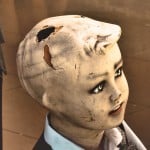
But enough horsing around… what the fuck is this Cover?
Originally, I was just going to end it with that, but fuck you, I have gone so far off the deep end that I can actually say something about it now, HAHA. This album gives us a glimpse into West Berlin during the wild '80s. Kreuzberg had (and still has, to some extent) quite the alternative scene, mainly because it had a high rate of artists, students, and squatters, and was THE punk and new wave hotspot (at least that's what I heard, I wasn’t born yet). One defining factor for this city was that it was enclosed by the Berlin Wall on three sides, which resulted in some low-quality housing. Protests happened here pretty often, and in the '80s, there was a “Nackt-Demo” against a ban on masking. As the name implies, the protesters were nude, only wearing masks. Now, I’m not saying that the protest and the cover are directly connected, but the abrasive and appalling nature of the cover and the spirit of the abrasive community that was willing to protest butt-naked are connected. If not tied directly to each other, they feel connected in spirit and their stand-offish antifascist ideology.
This album came out in 1989, only two months before the Berlin Wall fell. Whether intentional or not, this album is a neat little time capsule into a scene, which in the way it existed here, does not exist anymore. Even though I’m from Germany, I don't listen to German music, and if I do, it's probably not by my own accord. Still, I’m glad that I was able to cover this to this extent, even though it took much more effort than I anticipated. I’m not expecting anyone to actually read this shit, but if you did: First, I’m really sorry. I didn’t expect to talk about the funny-cum-horse to this extent. And second (but most importantly): Thank you! <3 *kisses your balls*

Related Content
Advertisement

Rate and review albums along with the AOTY community. Create an account today.
Become a Subscriber
Subscriber badge, no ads + more benefits.
Subscriber badge, no ads + more benefits.