
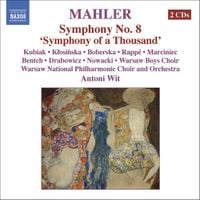
Antoni Wit, Barbara Kubiak, Izabella Kłosińska, Marta Boberska, Jadwiga Rappé, Ewa Marciniec, Timothy Bentch, Wojtek Drabowicz, Piotr Nowacki, Warszawski Chór Chłopięcy, Warsaw National Philharmonic Choir & Warsaw National Philharmonic Orchestra
Mahler: Symphony No. 8, 'Symphony of a Thousand'

85
Mahler Reference Recordings #8
Gustav Mahler's Eighth Symphony is by far his most epic and expansive work, making it exceedingly difficult for conductors to interpret. Due to its complex nature, there is little room for stylistic changes without affecting its core structure. As a conductor leading this titanic symphony, the best approach is to navigate through known and charted waters. I suggest that a literalist stance, involving a direct application of Mahler's instructions, is the only way to perform this work successfully.
Written in 1906, Mahler's so-called 'Symphony of a Thousand' was from its conception a work of immense grandeur. It represents a mutated reorganization of the standard sonata form, adopting a unique binary structure with two massive movements. The first movement aligns more with the traditional framework of symphonic progression, featuring typical development, recapitulation, and a coda. It's in the second movement, inspired by Goethe's "Faust," where the symphony's dramatic core unfolds, taking on a form reminiscent of a cantata. While Mahler's Eighth is arguably the most epic in his symphonic catalog in terms of sheer size, it doesn't compare emotionally to his Second Symphony, where themes of resurrection and redemption reach their zenith in a transcendental finale. In the Eighth, the finale, though grand, doesn't achieve the same level of meaningfulness or memorability as in the Second or even the Fifth Symphony. Here, we find Mahler completely unrestrained and unbridled. Whether this is a positive aspect is debatable; notable critics like Theodor Adorno and Jonathan Carr felt that the overwhelming positivity of the work detracted from its value.
In my experience, Antoni Wit's interpretation with the Warsaw Philharmonic is the most successful rendition of this symphony I have ever heard. It is clear, concise, and does not attempt to alter the text. Wit also excels in marshaling the complete sonic forces at his disposal towards the exhausting finale with measured intensity. While others, such as Bernstein and Bertini, have performed the work well, none have been as submitted to Mahler's vision as Wit.
Comments
Sign in to comment.
Related Content
Advertisement
Rate and review albums along with the AOTY community. Create an account today.
Become a Subscriber
Subscriber badge, no ads + more benefits.
Subscriber badge, no ads + more benefits.